The Operations Ceiling: How AI Business Automation Breaks the Human Bandwidth Limit
Every growing business eventually hits the same invisible wall: operations that can't move faster than the humans running them. This is the ceiling — and AI operational systems are the only thing that breaks it.
It's 3:07pm on a Friday.
Your best enterprise client sent an email at 9am about a billing discrepancy. Six hours ago. They've since sent two follow-ups, each one slightly more impatient than the last. By Monday morning, when your support team finally clears the weekend backlog and reaches their email, there will be a fourth message. From their CEO. Telling you they're moving to a competitor.
Nobody on your team failed. Nobody was lazy or incompetent. Your support team of four is working through 260 tickets this week — the same week two of them are out sick — and doing the best any four humans can possibly do. The math just doesn't work.
That email wasn't missed because of bad culture or poor hiring. It was missed because you built your operations on a foundation that has a hard ceiling: human bandwidth.
And you've hit it.
The Ceiling Almost Nobody Sees Coming
There's a growth stage that catches most businesses off guard. Revenue is climbing. Customers are signing. The product is working. And then — without anyone noticing until it's already happening — operations start to crack.
Response times stretch. Onboarding slows down. Support tickets pile up. Internal requests fall through gaps between tools. New hires take three months to be productive because the knowledge they need lives in the head of one senior person who is already stretched thin.
The knee-jerk response is always the same: we need to hire.
So you hire. And for a quarter, things improve. Then volume grows again, and you're back where you started — except now payroll is $200K higher and you have three new people to manage. The ceiling moved. It didn't disappear.
This is the trap. You're treating a systems problem as a headcount problem. And headcount is the most expensive, slowest, and most management-intensive solution to an operations bottleneck that exists.
The Villain Is the Architecture, Not Your Team
Let me be specific about what "human bandwidth" actually means as a constraint.
Right now, in most operations-heavy businesses, every piece of information retrieval requires a human. Every ticket response requires a human to read, understand, locate the answer, and write a reply. Every new hire question requires someone to stop what they're doing and answer it. Every internal process step that involves judgment requires a human in the loop — even if that judgment is the same judgment made 400 times per month.
That's the architecture. And it has a throughput ceiling that no amount of culture, tooling, or motivation can break through. Physics sets the limit.
A support rep can handle maybe 50 tickets per day if they're fast and the tickets aren't complex. Five reps means 250 tickets per day capacity. If your volume is 300 tickets per day, you're always behind — and you will always be behind until you either hire a sixth rep (at $60K/year) or you change the architecture.
The villain here is not your team. It's the assumption that humans-as-processors is the only model available to you. It isn't. It just used to be.
What Happened When One Business Stopped Hiring and Started Building
One of the most clarifying cases we've seen at Arcetta was a professional services company at $6M annual revenue. Forty-five employees. Support team of five handling around 300 tickets per week. A senior operations manager spending 35% of her time answering the same 20 questions that came up constantly — from clients, from her own team, from new hires trying to figure out how anything worked.
They'd hired three additional people over the previous 18 months. Response times were still averaging 3–4 business days. New hire ramp time was 11–12 weeks. The senior ops manager was close to burning out.
Their read on the situation: we just need more people.
Our read: they had a bandwidth architecture problem. The information and decisions needed to serve customers and run the business were locked inside human minds and scattered across Notion pages, Slack threads, and email inboxes. Every time someone needed anything, a human had to stop and retrieve it for them.
We built three systems over eight weeks:
- An AI customer support layer that handles tier-1 tickets autonomously — billing questions, policy lookups, status updates, common troubleshooting flows. Fully integrated with their CRM and ticketing system. Escalates to humans when confidence is low or the issue is flagged as high-value.
- An internal AI knowledge base that makes their entire documentation, SOP library, and policy archive queryable in natural language. New hire asks "what's our refund policy for clients over 90 days?" — they get the answer in seconds, with a source link, without pinging anyone.
- An intelligent triage and routing layer that reads every inbound ticket, classifies intent, pulls relevant account context, and either resolves it autonomously or routes it to the right human with a summary and recommended action already prepared.
The results at 60 days:
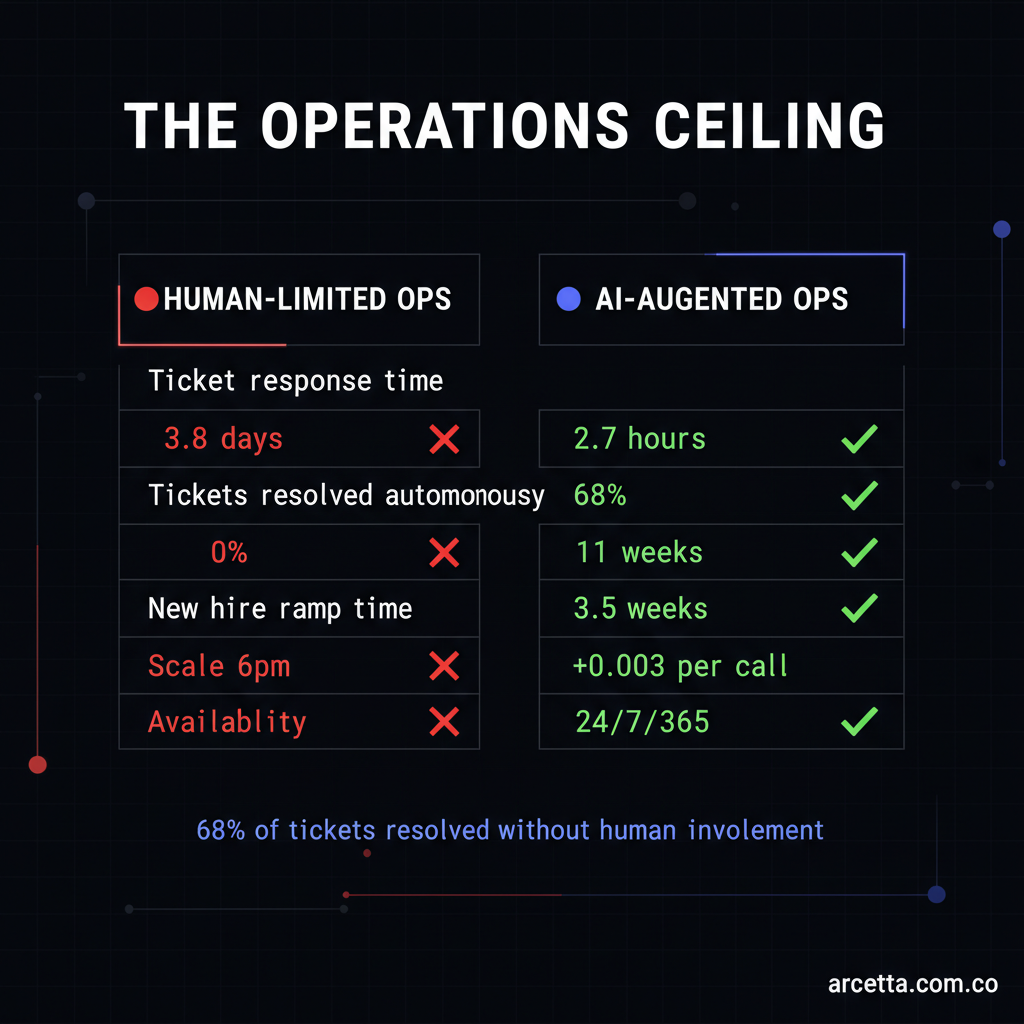
- Average ticket response time: 3.8 days → 2.7 hours
- Tickets resolved without human involvement: 68%
- New hire ramp time: 11 weeks → 3.5 weeks
- Senior ops manager time on repetitive Q&A: 35% → 4%
They didn't hire a sixth support rep. They reduced the team to three — and those three now handle a higher volume with less stress because the AI layer absorbs everything that doesn't require genuine human judgment.
The Bandwidth Architecture: Arcetta's Framework
What we did in that case follows a repeatable framework we use in every engagement. We call it the Bandwidth Architecture — four stages that move a business from human-limited operations to AI-augmented operations.
Stage 1: LOCATE
Map every process where human bandwidth is the constraint. Not where things feel hard — where throughput is actually capped by the number of hours a human can work. Support ticket volume. Inbound lead response time. Onboarding steps that require a senior team member's time. Recurring internal requests. These are your bandwidth bottlenecks.
Stage 2: ARCHITECT
For each bottleneck, design the AI layer. This means deciding: which interactions can be handled autonomously, which need AI-assisted human handling, and which genuinely require unaugmented human judgment. The architecture specifies what data the AI needs, what integrations are required, and what the escalation logic looks like when the AI's confidence is low.
Stage 3: CONNECT
Wire the AI layer to your live data. This is the step most chatbot deployments skip — which is why most chatbots are useless. An AI system that can't see your customer's account history, order status, or previous interactions can't resolve their issue. It can only retrieve FAQ entries. Connection to real data is what separates a tool that deflects from a tool that resolves.
Stage 4: OPTIMIZE
Measure resolution rate (not deflection rate), monitor escalation patterns, and improve from real usage data. The first deployment is not the final state. Every week of live usage tells you which scenarios the AI handles confidently and which it mishandles — and that data drives continuous improvement without rebuilding from scratch.
The Three Signals That Tell You You're Ready
Not every business is at the right stage for AI operational systems. Here's how to know if you are.
Signal 1: Repeating the same decisions
If your team is making the same judgment call, answering the same question, or executing the same multi-step process more than 50 times per month — that's a candidate for AI. The higher the volume, the more leverage you get from automating it.
Signal 2: Hiring hasn't solved the problem
If you've added headcount in the last 12 months and the same operational friction still exists — just at higher scale — you're dealing with an architecture problem that headcount can't fix. That's the signal to change the model.
Signal 3: Your best people are doing your most routine work
When a senior ops manager is answering the same 20 questions every week, or your support leads are personally handling tickets that could be automated, you're burning high-cost human judgment on low-value repetition. That's the clearest signal that the architecture needs to change.
What This Actually Costs — and What It Returns
The honest answer on cost: a properly built AI operational system for a 30–100 person company runs between $15K and $60K in implementation, depending on complexity and integrations, with ongoing API costs that are typically a fraction of what one additional headcount would cost.
The return side:
- A support rep at $50K/year costs $58K fully loaded. If AI handles 65% of their ticket volume, you're getting the equivalent of 0.65 headcount from infrastructure, not salary.
- A senior ops manager spending 35% of her time on repetitive Q&A is costing you 35% of her annual comp in lost leverage — usually $30K–50K/year for nothing.
- Onboarding that takes 11 weeks instead of 3 costs 8 weeks of partial productivity per new hire — at a junior level, roughly $8K–12K per head.
Most clients see full ROI within 4–6 months. The ongoing advantage is compounding: as volume grows, the AI layer handles more without additional cost — which means margins expand rather than compress as you scale.
The Move
The businesses that build AI operational infrastructure now will have a structural cost and speed advantage over competitors who wait. Not because AI is hype — but because the math works and it compounds.
If any of what you've read here describes your current situation — tickets piling up, hiring not solving the problem, best people buried in repetitive work — that's the ceiling. And it's breakable.
A strategy call with Arcetta takes 30 minutes. No deck, no pitch. We map your bandwidth constraints against the Bandwidth Architecture framework and show you exactly which AI systems create the highest leverage for your specific operation. You leave with a clear roadmap — whether you work with us or not.
Ready to Automate Your Operations?
Book a strategy call and we'll map out exactly which AI systems will have the highest impact for your business.